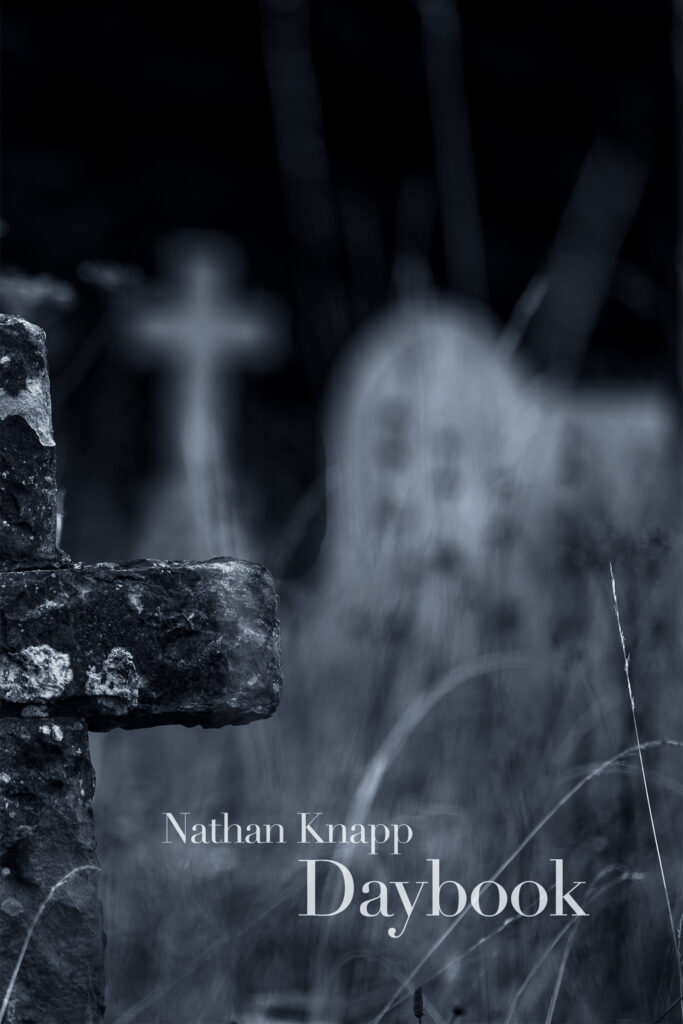
Daybook
by Nathan Knapp
Hardback: £15.99
Paperback: £10.99
ePub: £3.99
Longlisted for the 2025 Republic of Consciousness Prize
How can a person speak when they lose faith in the authority of their voice? One night on the cusp of winter, a man sits alone, in silence, and begins to lay words on an empty page. He speaks of ancestry and stymied ambitions, of confusions and doubts, of what he despises and what he adores. He speaks of scripture and commandments, of conformity and evangelism; he speaks of the lust and the shame that have led him away from a doctrinaire upbringing, and of the love that has sheltered him in his spiritual exile. And yet, in order to speak of these things, he finds he must speak back to things he has already said: so he returns to his earlier words and casts doubt on their veracity, to elucidate the implications that were lost when he wrote them down.
Nathan Knapp’s Daybook marks the arrival of a blazing new talent in contemporary literature, the Gerald Murnane of the American South. In the sinuous, incantatory style of a fugue in prose—and teasing out the tensions between carnality and theology, desire and disgrace—Knapp embarks on a dreamlike exploration of life’s most essential, enigmatic questions. The result is self-conscious, self-lacerating, and self-deprecating, both deeply serious and darkly funny: a testament to what a voice can say when it speaks without intent, with only a hunch that it might create meaning.
About the Author
Nathan Knapp lives in Nashville, Tennessee. Daybook is his first novel.
Bonus Content
Read excerpts from Daybook:
Read an excerpt at minor literature[s].
Read an excerpt at 3:AM Magazine.
Read an interview with Nathan Knapp at 3:AM Magazine.
Read an interview with Nathan Knapp at Full Stop.
Listen to Nathan Knapp interviewed on the Beyond the Zero podcast.
Listen to Nathan Knapp interviewed on the hu u no podcast.
Praise for Nathan Knapp
A strange, sombre novel in which a troubled young writer unpacks the legacy of his religious upbringing. Told in the form of a memoir, prone to Bernhardian digressions, it devolves into a quietly absorbing meditation on literature, mortality, and sexual shame.
Judges’ Citation
2025 Republic of Consciousness Prize
Many questions are asked, some are never answered, some are answered so many times that they revert to questions. The very spaces between the sentences are heavy with unspoken movement. You don’t know where you are, and you know exactly, which is only and precisely what a great novel does.
Emily Hall
author of The Longcut
Flaubert famously wanted to one day write a book about nothing, and although Nathan Knapp’s Daybook isn’t that exactly, it is, I think, precisely the kind of book that Flaubert would nevertheless have admired: oddly propulsive by virtue of its prose, devoid of received and insincere ideas, resistant to facile reduction, new. A book like this one — a book that asks its reader to reflect critically on how they’ve spent their limited time alive while also reassuring its reader their time has been well spent in reading it — is exceedingly rare.
Gabriel Blackwell
author of Babel and Doom Town
Can a book be haunted and exuberant at the same time? Can it be funny and the saddest thing you’ve ever read? Can it feel like it was improvised live on stage while its sentences were chiseled in stone? I don’t know how Nathan Knapp pulled this off, but the result is exactly what I’m always looking for: an absolutely one-of-a-kind book that held me rapt from the first word to the last.
Ben Loory
author of Tales of Falling and Flying
Knapp’s admissions of sexual desires out of line with his upbringing… are bracing in their unvarnished bluntness. His interactions with cam girls and strippers ride the line between deadpan comedy and sad sack confession. It’s a rare candor on a subject few writers handle well. … Yo-yoing between youthful scenes, present day observations, and self-conscious references to the writing of the book itself, the result is a kind of psychogeographical prose poem. … It’s one of the best pieces of contemporary writing I’ve read in the last few years.
Dmitry Samarov
Maudlin House
Nathan Knapp’s début novel, Daybook, is fiendishly difficult to encapsulate: it’s a novel of philosophical and moral depth, of stylistic ambition and assuredness, of biting humour, self-exposure, and extraordinary emotional intelligence. It’s a very contemporary novel, moving from the ethics of livestreamed interactive pornography to the effects of Covid-19 lockdowns on love between intimate partners, and it packs in much more than you’d expect from a slim 150 pages.
Daniel Davis Wood
3:AM Magazine
Daybook [is] a short, criminally overlooked novel… hilarious and unforgettable. … In less than 150 pages, Knapp takes on sex, ghosts, racism, returning home, losing one’s Christian faith, and the state of universities. Daybook is fugue-like, an off-the-cuff running monologue that achieves mesmerizing immediacy while never attempting to curry the reader’s favor or approval.
John Julius Reel
The Metropolitan Review
Death permeates these pages all the way through. We amble along gravesites in cemeteries and battlegrounds. But desire is perhaps the book’s primary subject: sexual and aesthetic desire. How complicated these fraught impulses can be in our current era, especially if we allow ourselves to be honest about them — categories and shame be damned. This is a brave book, like no other I’ve read. It’s an attempt to reckon with the paradoxes of the American quotidian and locate rarified beauty in its crevices. We spiral in and out of a consciousness that is self-aware, vulnerable, and absolutely committed to his art.
Jason Christian
Full Stop