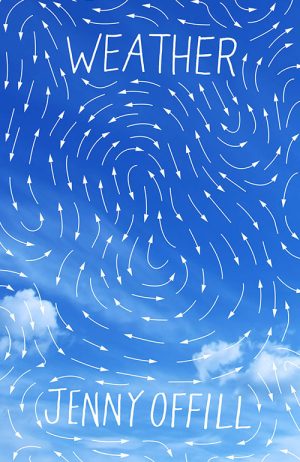
Anna MacDonald reviews Jenny Offill’s Weather.
This first time, I read Weather in one sitting, the same way I read Offill’s previous novel, Dept. of Speculation, back in 2014. I was living a different life then, alone in an apartment by the river but in good company. Early every morning I would look out my window to the apartment block across the way. Over coffee, from my reading chair, I’d steal glances at another reader two floors below: a woman who sat on her kitchen bench with her bare feet in the sink. No matter the weather, the window was always slightly ajar. Through it the woman blew clouds of smoke and ashed her cigarette. She held a cup of coffee in one hand. A book was always open on her lap. The book changed every few days.
I remember it was a Sunday when I read Dept. of Speculation. And I remember the sense, as I encountered Jenny Offill for the first time, that the world and the ways of representing it were expanding: like the universe and beyond measure.
The world has changed in the six years since 2014. Can it really be only six years? (“My # 1 fear is the acceleration of days,” declares Lizzie, the narrator of Weather. “No such thing, supposedly, but I swear I can feel it.”) And there’s a moment in Weather that I keep returning to. It’s at about the half way point, after the last US election — that pivotal moment in this novel, in the world as we all know it — when Ben, Lizzie’s husband — Ben, who has been such a consolation until this point, who has remained steadfastly unhysterical in the face of all the ways to be desperately afraid, who does not panic and, when confronted with “the uptick in dread”, insists only that he be shown “the math” — Ben has announced that “the path is getting… narrower.” “That’s how Ben told me”, Lizzie tells us. “He was doing the math in his head.” And then Ben asks, “Should we get a gun?”
That first time, I read Weather quickly; I wanted to get a sense of its shape. Then I reread it slowly over the course of a week. I made too many notes, found myself transcribing whole pages of the novel. Looking back through my notebook now, I read in the margins: the individual and the collective; safety first!; survival skills (see doomstead); optimism; captivity (everything, everyone is caged); unprecedented times?? history; sleeping pills; optimism?; Mars; late capitalism; mobility; enmeshment; “The Domestication of Death”; kindness & decency; interconnected; glaciers; failure to connect; Mars; survival; history; bad decisions; See coral p.41. Also, the historical view; Antarctic survival colonies; the language of climate change; math; optimism; drugs; the future is here; climate grief; smart deer — panic in captivity; historical/global view; captivity; captivity; history; culture of denunciation; “suffering = pain + resistance” (you do the math); hate; captivity; Q: Can a recognition of / sacrifice to past sorrows help to abate present-future sorrow?; hope, witness; doomstead; withdrawal; suffering; home / captivity; face transplant; loss-proofing; group survival purpose; What is “the cultural trance”??; history; mobility — at a time when governments are fortifying against crossing borders unless, of course, you’re “very, very rich”, this is not for the most vulnerable, “the invisible hand”; time; history; mobility — I’m thinking of lemmings; and, repeated on every other page, more and more insistently, the core delusion, the core delusion, “the core delusion is that I am here and you are there”.
Todays weather
I take an introductory meditation class. My thinking mind won’t shut up. But when the instructor tells me that in this present moment I am being breathed, I realise that’s the language I’ve been looking for. Because, reading Weather, I feel that in this present moment I am being read.
I live in a country led (I use the term in its loosest sense) by a man who employed consultants — at significant taxpayer expense — to advise his government “on how to empathise with drought stricken communities across three states”.
We are living through a summer of unprecedented — but not unpredicted — fire danger. Someone, somewhere, is always doing the math. In 2008, the Garnaut Climate Change Review warned that “fire seasons will start earlier, end slightly later, and generally be more intense.” “This effect,” the report stated, “increases over time, but should be directly observable by 2020.”
To recap. On December 30, 2019, there are reports that Mallacoota is under threat from a fire that has already been burning through East Gippsland for weeks. Mallacoota is an isolated town at the far eastern point of Victoria. It has a river as well as access to the sea and is surrounded by National Park. There is one road in and out. My friend and boss, Rosy, lives there. And although I’ve never visited, it’s the kind of place where, I imagine, Lizzie might build her doomstead. Certainly, it’s the kind of place that, until this summer, I would have imagined building mine.
By the time I finish up at the bookshop on December 30, I’m worried but I don’t yet believe in the worst. (Show me the math!) I send Rosy a message, hoping she’s safe and that things don’t become too frightening overnight. Then I go home. I check the news again before bed. The fire hasn’t yet reached the town. But people have been told that it’s too late to leave. The next morning, early, I wake to images of four thousand people and their pets who have evacuated their homes and camping grounds and congregated on the beach. Fire trucks line the main street of town. The people on the foreshore have been told that when the trucks activate their sirens, everyone is to move to the waterline. I check my Twitter feed: “The sirens have just been activated.”
No word yet from Rosy. I am wholly helpless, full of fear that I cannot direct to any useful purpose. (group survival purpose) In the end, I figure that the only thing I can do is keep the bookshop going. So I get dressed, take the train into town, open up and sell books on this horribly frightening day. Much later, there’s a message from Rosy. She is safe. Her house is safe. Others, of course, have not been so lucky. But the relief is immense.
It’s New Year’s Eve 2019 and I’m in bed before ten. Far from the fires, I’m left emptied out of many things, and I feel guilty that my own small sense of safety is among them. In their place, I have a new vocabulary — ember attack, fire tornado, state of disaster — and a few new skills. I now know how to navigate the websites of the State Emergency Services and the Environment Protection Authority.
Lizzie, who is a “feral librarian” — a librarian who doesn’t have a formal qualification — takes a second job answering emails for her friend, Sylvia. Sylvia runs a podcast called ‘Hell or High Water’. She gets asked a lot of questions. Questions like this one:
Q: How did we end up here?
A: We can, if need be, ransack the whole globe, penetrate into the bowels of the earth, descend to the bottom of the deep, travel to the farthest regions of this world, to acquire wealth, to increase our knowledge, or even only to please our eye and fancy.(William Derham, 1711)
Todays weather
At the bookshop, a customer spends a long time telling me that “progressives” (among whose number, I assume, he counts himself) are more depressed than “other” people because they care about the world. It’s been a long day. The shop looks onto a Salvation Army shelter, which is closed today, and for hours a woman has stood at the door screaming to be let in. Every few minutes, a man shouts across the road at her to “shut the fuck up you filthy cunt”. I feel like weeping. So I don’t tell this customer (who is now talking loudly about “deplorables”) what I think: that this divisive talk of “progressives” against the rest of the unenlightened world is one of the reasons we’re all in this almighty mess, together.
Lizzie’s boss at the library has only ever given her one piece of advice: “look after your teeth.” Last week, I took it, and visited the dentist who subsequently informed me that my teeth have stress fractures, which indicates that I’ve been either grinding or clenching them while I sleep. Now, it occurs to me that these stress fractures have been caused not because I’m clenching my teeth overnight, but because I’m clenching my teeth all day.
At the library, Lizzie and her colleagues are given this guide: Tips for Dealing with Problem Patrons. Problem patrons are classed according to these categories:
Malodorus
Humming
Laughing
Defacing
Laundering
Combative
Chattering
Lonely
Coughing
When I worked nights at the bookshop there was a man who came in most evenings and spent hours sitting on the stool near the poetry section. He liked to play the lip trumpet when the mood took him. He was actually quite good. Once in a while he would make a purchase. He bought interesting books. He was always very careful around the chip reader on the credit card machine. But I didn’t really start to worry until he began talking, obsessively, about the transmitters the government had somehow installed in his balls.
I can’t stop thinking about the discount prescription catalogue. In the end, I dig it out of the recycling bin. I’m curious to know how many of these drugs are familiar to me. I want to know what symptoms they’re intended to treat. Somac, I know, is for gastric ulcers. Viagra, no explanation necessary. Prozac, ditto. Circadin, I can guess. Ventolin, check. A few names I think I recognise as antibiotics. As for the other eleven and three-quarter pages, there’s a narrative there if only I had the stomach for it.
Lizzie reads an article about face transplants:
The magazine warned me at the beginning that there would be disturbing pictures, but not how long they would disturb me or how I’d remember that Henry told me once a gun is best because you have to do the math just right with pills. And there was no warning at all about the words in the article…
I live in Australia’s second most populous city, well away from those areas that have, traditionally, been considered a bush fire risk. But like most people in this place, and still a lot less than some, I’ve lived with the fear of fire all my life. I grew up next door to a burns victim of the 1983 Ash Wednesday fires, and with the stories of how he received his injuries. I remember that he was driving away from the front with a woman and her son when his car was engulfed by flames. They did all the right things. They stopped the car, they sheltered under woollen blankets. But the woman panicked. Within the belly of the fire she opened the car door to escape. Later, only her rubber thongs were found, melted into the bitumen. Her son got to a hospital, but finally died from his injuries. My neighbour lost most of the fingers on both hands. I remember that throughout my childhood he was in and out of hospital for further amputations, new skin grafts. During one visit, the blood transfusion he received left him with Hepatitis C. This neighbour’s back verandah ran alongside my bedroom wall. For years I fell asleep to the sound of him pulling the ring on a beer can, crunching the can when he was done, tossing it over the balustrade where it met the other empties with a metallic tock. On Black Saturday in 2009, I was at a family wedding. The husband of one of my cousins was a member of the Country Fire Association, and throughout the ceremony his phone pinged repeatedly with news of new fires, fears of growing fatalities. Back home that night the news was all bad. In Marysville, where since my teens we had holidayed every autumn, one police officer reported: “The main street… no longer exists. … The motel at one end of it partially exists. The bakery has survived. Don’t ask me how. Everything else is just nuked. Words can’t describe the devastation. I don’t ever want to experience it again.” Eleven years have passed since Black Saturday, and I still haven’t returned to Marysville.
This is, I suppose, a roundabout way of saying that I thought I was prepared for longer and increasingly severe fire seasons. I thought I was prepared for rising temperatures and everything that (I thought I knew) would come with them. Before I bought my riverside apartment — over a decade ago, now — I checked a website that predicted the effect on property of rising sea levels. My apartment is on top of a hill. In the future, it will be closer to the river’s edge. Its views will be more picturesque. I thought I was prepared for the threat of extinction — human and other animal. But now, it turns out, I wasn’t prepared for what it would feel like to read that “more than a billion animals have died around the country — a figure that excludes fish, frogs, bats and insects.” I hadn’t expected the new vocabulary I would have to learn. I hadn’t anticipated the new routines, the need to check the air quality as well as the weather before leaving home, before even thinking of opening a window. It turns out that reading about the future and living there are altogether different things.
Todays weather
I take a soundmind meditation class. The instructor tells me to imagine a golden light expanding from my lower belly down my legs sending roots through the rock and the earth and the water. With each exhalation, she says, release the tension in your body along these golden roots, into the rock and the water, into the earth. The mind, she says, has no problem to solve in the present moment. But I cannot release my tension into the rock and the water, into the earth. At this present moment, to my mind, the earth has enough problems. I try to solve the problem by releasing my tension into the air, as I’ve been instructed to do in other meditation classes. But according to the latest EPA readings, the air quality is already hazardous. So I’m left with this problem.
Q: If I cannot release my tension into the earth, and I cannot release it into the air, and I cannot keep it locked up in this aching body, where can I put it? What will be the safest place?
One of the questions that Sylvia gets asked a lot is: “What will be the safest place?”
There seem to be two principal schools of thought. Actually, three if you count the most terrifying — that “no one is safe … Safe?” — and four if you count the most likely, and for the majority the most out of reach: “become very, very rich”. As for the principal two: build a doomstead, or be as mobile as possible.
Lizzie watches an interview with an Australian climatologist, who says:
I find it really hard to decide on one particular region, saying this one is going to be safe and we are just going to lock this one in. I don’t think there will be any safe places. I am… the impacts are going to be big. So my approach is to be as mobile, as flexible as possible, to be able to adapt to whatever is going to happen. My children are bilingual and we’re working on a third language. Both children have three passports, and they actually have the freedom to be able to study and work even in the European Union, or in Canada, or in Australia.
I also watched this interview when it aired a couple of years ago, and I’m still torn between the horror of the future this woman has seen — yes, she’s done the math — and the rage that fills me at the thought that the majority of people — adults and children as well as all the other animals — don’t even have one passport, so that for the most vulnerable freedom of movement will never be an option.
Don’t be fooled by everyone else’s calm. Get out even when nobody is even considering it yet. When you look at 2060, southern Argentina might be a good place for your children since it’s close to the Antarctic peninsula, the place where the survivor colonies will be built.
Todays weather
In Antarctica, a man has swum in a river formed by the melt from a polar ice sheet. I don’t even need to zoom in to see that he’s only wearing speedos, a swimming cap and goggles.
After the election Lizzie meets Will, a hot war correspondent. Her question for Will is this:
Q: Does this feel like a country at peace or at war?
A: … it feels the way it does just before it starts.
At one of Sylvia’s lectures, an audience member asks the following question:
Q: How do you maintain your optimism?
A:
Q: How do you maintain your optimism? A: Me? With this thought: the core delusion is that I am here and you are there. And with the hope that, because I am here and you are here, and because we are angry as well as afraid, today’s bad weather might — neither moderately, nor without extreme suffering — lead us to resist, collectively.